Annual Reports
Fiserv, Inc.'s annual reports contain management's most considered account of the business. These are the sections, passages and visual pages worth opening in the originals preserved in Sources.
Fiserv, Inc. — FY2025 Annual Report (Form 10-K) — FY2025
The first 10-K after the 2025 reset: it defines the One Fiserv action plan and discloses how thin the goodwill cushion has become. · Open the full document →
Item 1. Business — Overview — p. 5 · Read the full section →
Sets scale and revenue character in one place: $21.2 billion of revenue, 80% of it recurring processing fees on multi-year contracts.
Management's own framing of scale, recurring revenue and the non-discretionary nature of the services.
Fiserv, Inc. is a leading global provider of payments and financial services technology solutions. We are publicly traded on the NASDAQ Global Select Market and part of the S&P 500 Index. […] Most of the products and services we provide are necessary for our clients to operate their businesses and are therefore non-discretionary in nature. […] In 2025, we had $21.2 billion in total revenue, $5.8 billion in operating income and $6.1 billion of net cash provided by operating activities. Processing and services revenue, which in 2025 represented 80% of our total revenue, is primarily generated from account and transaction-based fees under multi-year contracts that generally have high renewal rates.
p. 5 · Read in context →
Merchant Solutions — p. 5 · Read the full section →
The larger segment by revenue, and the one whose growth rests on Clover and on a distribution chain the company does not fully own.
What the Merchant segment sells, and the partner channels it depends on to sell it.
The businesses in our Merchant segment provide commerce-enabling products and services to companies of all sizes around the world. […] We distribute the products and services in the Merchant segment businesses through a variety of channels, including direct sales teams, strategic partnerships with agent sales forces, ISVs, independent sales organizations (“ISOs”), financial institutions and other strategic partners in the form of joint venture alliances, revenue sharing alliances and referral agreements.
p. 5 · Read in context →
Where Clover is being pushed next — verticals beyond restaurant and retail.
We offer merchant acquiring solutions to enable small businesses to securely accept payment transactions online or in-person. […] We are growing Clover through new and expanded partnerships, industries and geographies. Our focus remains on high-growth industry verticals such as healthcare, e-commerce, and professional services, while maintaining a strong presence in restaurant and retail.
p. 7 · Read in context →
Financial Solutions — p. 8 · Read the full section →
The higher-margin segment: core account processing and debit networks, plus the newer embedded-finance and stablecoin work.
The Financial segment's client base and the debit-processing services at its core.
The businesses in our Financial segment provide products and services to financial institutions, corporate and public sector clients across the world, enabling the processing of customer loan and deposit accounts, digital payments and card transactions. […] We provide debit card processing services, which include tokenization, loyalty and reward programs; customized authorization processing; gateway processing to payment networks; ATM managed services and cash and logistics management; and risk management products.
p. 8 · Read in context →
How Finxact, Payfare and Commerce Hub are assembled into the embedded-finance stack, and where FIUSD sits.
We have developed a comprehensive end-to-end embedded finance solution that supports various payment flows. This solution is built on a sophisticated ledger powered by Finxact to record transactions between buyers and sellers; an orchestration layer powered by Payfare to manage each transaction; and payment acceptance powered by Commerce Hub. Together, these components support all payment flows for payouts, returns, and reconciliations. […] We are building our stablecoin capabilities with the launch of FIUSD, embedded within our existing banking and payments ecosystem, which allows customers access to more efficient and interoperable digital asset service.
p. 10 · Read in context →
Our Strategy — p. 12 · Read the full section →
The strategy section rewritten around One Fiserv — worth reading against the FY2023 version below to see how much the framing changed.
The strategic framing that replaced the prior 'move money and information' aspiration.
We are committed to delivering exceptional client service, world-class execution, and innovative value-added solutions. Our leading payment platforms and robust portfolio of value-added technology solutions position us at the intersection of finance and commerce. […] We have strong conviction in our assets, talent, strategy and our ability to execute and innovate. Consistent with this focus, we launched our One Fiserv action plan and are operating our business under the following strategic framework:
p. 12 · Read in context →
Item 1A. Risk Factors — Competitive and Business Risks — p. 21 · Read the full section →
Two company-specific risks: whether the One Fiserv plan delivers, and the alliance structure that lost the Wells Fargo joint venture.
The five One Fiserv pillars, followed by management's own list of what could keep them from paying off.
In 2025, we announced a strategic plan, referred to as the One Fiserv action plan, that focuses on: operating with a client-first mindset to win new enterprise clients and grow average revenue per client; building the pre-eminent small business operating platform throug Clover; creating differentiated, innovative platforms in finance and commerce, including embedded finance and stablecoin; delivering operational excellence enabled by artificial intelligence; and employing disciplined capital allocation for the long-term. To successfully execute the plan, we must implement operational, technological and cultural changes across our organization, which may be difficult to do. […] As a result, the actual benefits of the plan may be less significant than anticipated. Furthermore, we may not be able to achieve expected benefits of the plan on our anticipated timeline or at all.
p. 23 · Read in context →
The alliance model explained, and the admission that these fixed-term arrangements may not renew.
Under our alliance program, a bank or other institution forms an alliance with us, generally on an exclusive basis, either contractually or through a separate legal entity. […] Our merchant acquiring business depends, in part, on our merchant relationships, alliances and other distribution channels. There can be no guarantee that we will achieve growth in our merchant relationships, alliances or other distribution channels. In addition, our contractual arrangements with merchants and merchant alliance partners are for fixed terms and may allow for early termination upon the occurrence of certain events. There can be no assurance that we will be able to renew our contractual arrangements with these merchants or merchant alliance partners on similar terms or at all.
p. 24 · Read in context →
Item 1A. Risk Factors — Organizational and Financial Risks — p. 34 · Read the full section →
The balance-sheet pair that sizes the downside: goodwill and intangibles at roughly 60% of assets, against about $29 billion of debt.
The stated debt load and the specific flexibilities management says it costs.
At December 31, 2025, we had approximately $29 billion of debt. We and our subsidiaries may incur additional indebtedness in the future. Our indebtedness could: decrease our ability to obtain additional financing for working capital, capital expenditures, general corporate or other purposes; limit our flexibility to make acquisitions; increase our cash requirements to support the payment of interest; limit our flexibility in planning for, or reacting to, changes in our business and our industry; limit our ability to return capital to shareholders, including through share repurchases; and increase our vulnerability to adverse changes in general economic and industry conditions.
p. 36 · Read in context →
Item 7. MD&A — One Fiserv Action Plan — p. 49 · Read the full section →
Management's fullest description of the transformation launched in Q3 2025, including the AI and process work behind it.
What the plan actually asks the organization to do, in management's words.
In the third quarter of 2025, we launched the One Fiserv action plan designed to prioritize and enhance client focus across five strategic pillars. […] To advance this transformation, we are simplifying and standardizing processes, adopting new ways of working, and embedding AI to create a higher-quality, more productive business. This approach rethinks how business functions operate and aligns our product portfolio for the future. We are modernizing our technology infrastructure, enhancing resiliency, and reengineering our operating mode through AI and advanced automation.
p. 49 · Read in context →
Critical Accounting Policies and Estimates — Goodwill and Intangible Assets — p. 53 · Read the full section →
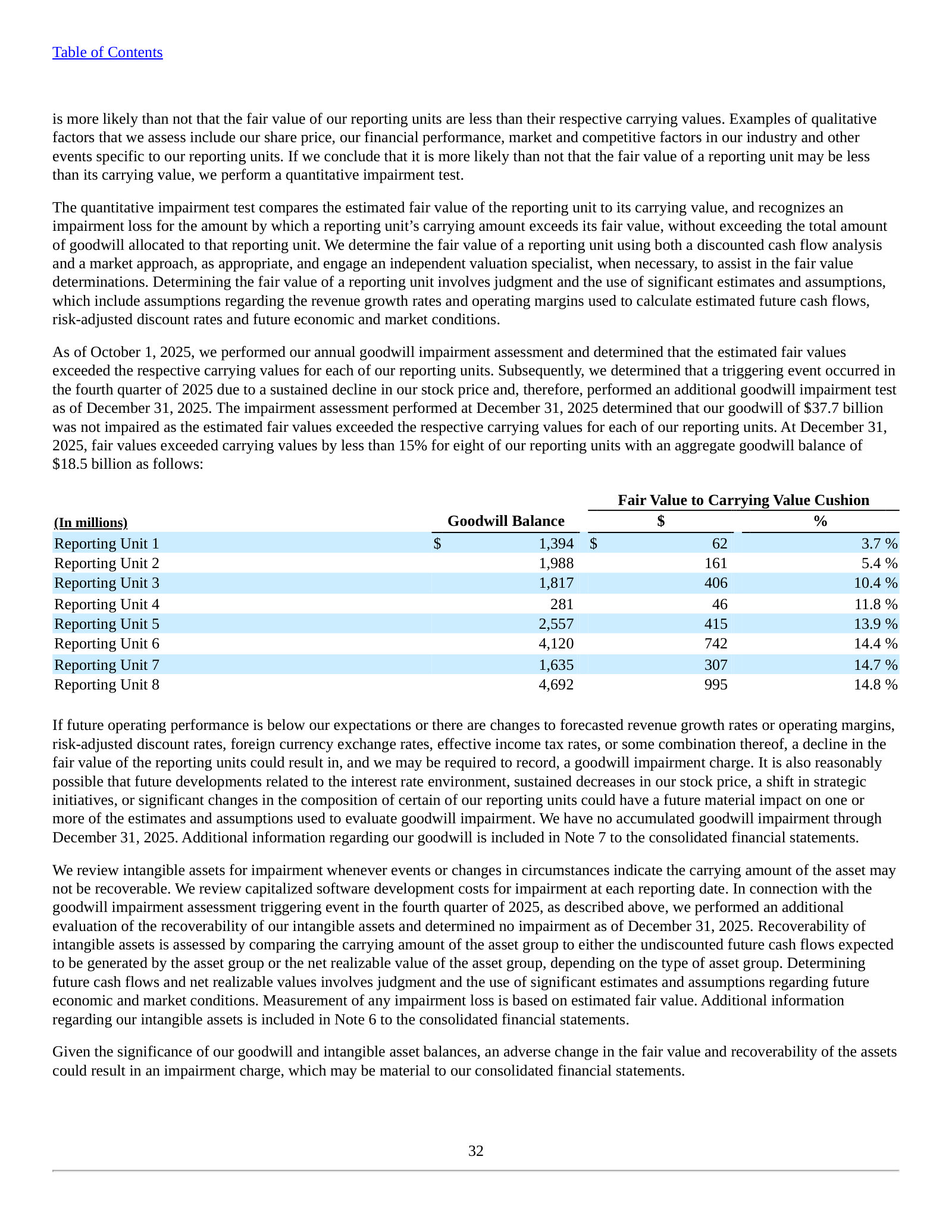
Ties the share-price decline to the balance sheet: a Q4 triggering event, no impairment, and eight reporting units under a 15% cushion.
A fourth-quarter triggering event from the stock-price decline forced a second goodwill test; $37.7 billion survived it.
As of October 1, 2025, we performed our annual goodwill impairment assessment and determined that the estimated fair values exceeded the respective carrying values for each of our reporting units. Subsequently, we determined that a triggering event occurred in the fourth quarter of 2025 due to a sustained decline in our stock price and, therefore, performed an additional goodwill impairment test as of December 31, 2025. The impairment assessment performed at December 31, 2025 determined that our goodwill of $37.7 billion was not impaired as the estimated fair values exceeded the respective carrying values for each of our reporting units. At December 31, 2025, fair values exceeded carrying values by less than 15% for eight of our reporting units with an aggregate goodwill balance of $18.5 billion as follows:
p. 55 · Read in context →
Item 7. MD&A — Results of Operations — p. 59 · Read the full section →
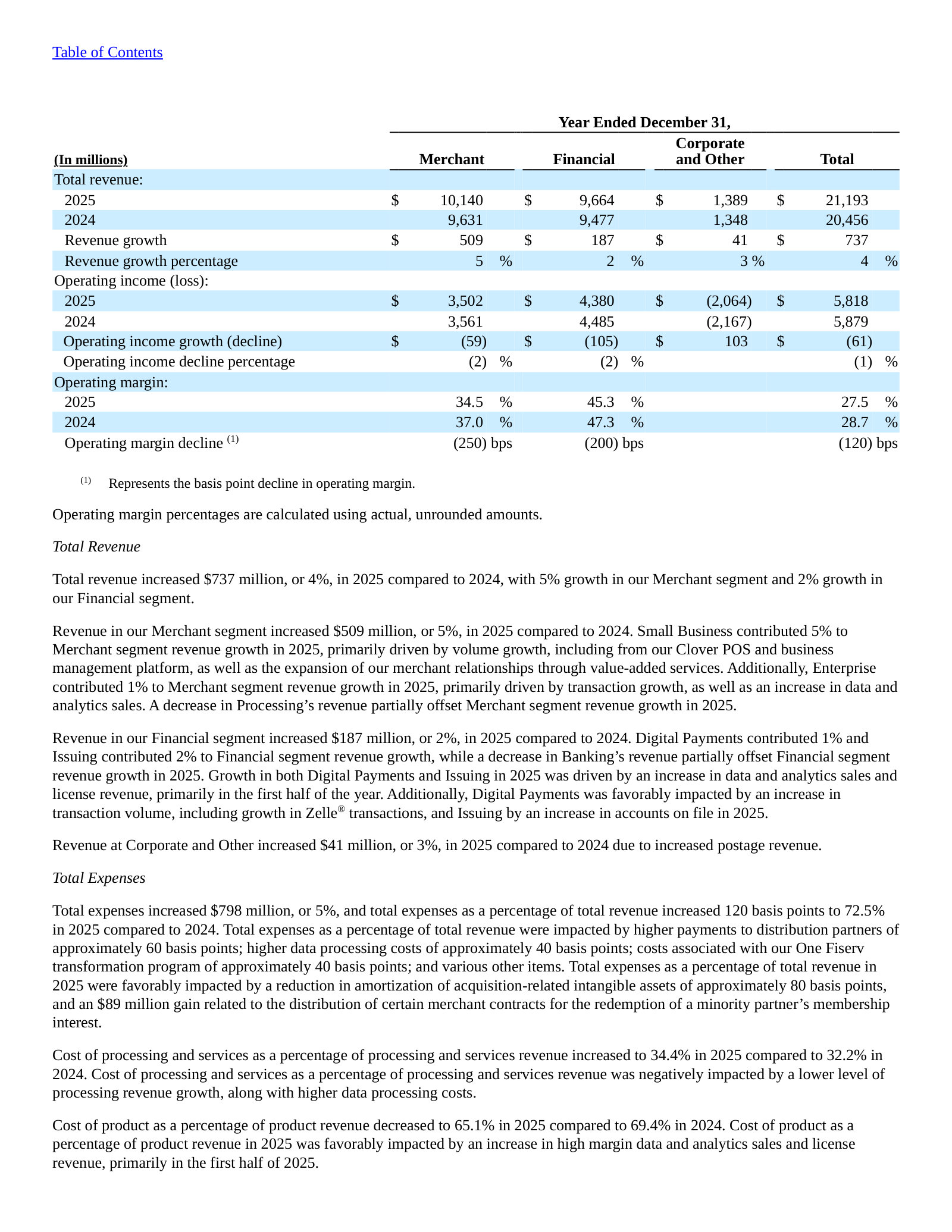
Where the year is explained: 4% revenue growth alongside margin decline in both segments, with the drivers named line by line.
Fiserv, Inc. — FY2023 Annual Report (Form 10-K) — FY2023
The last 10-K under the three-segment structure, and the one announcing the realignment into today's Merchant and Financial segments. · Open the full document →
Item 1. Business — Overview — p. 6 · Read the full section →
The 'before' picture: $19.1 billion of revenue reported across Acceptance, Fintech and Payments — three segments that no longer exist.
Scale and the three-segment structure as reported for 2023.
In 2023, we had $19.1 billion in total revenue, $5.0 billion in operating income and $5.2 billion of net cash provided by operating activities. Processing and services revenue, which in 2023 represented 82% of our total revenue, is primarily generated from account and transaction-based fees under multi-year contracts that generally have high renewal rates. […] Our operations are comprised of the Merchant Acceptance (“Acceptance”) segment, the Financial Technology (“Fintech”) segment and the Payments and Network (“Payments”) segment.
p. 6 · Read in context →
More annual reports
Fiserv, Inc. — FY2024 Annual Report (Form 10-K) — FY2024 · 172 pages · First year reported on the two-segment basis, and the pre-reset baseline: 28.7% operating margin against 27.5% in 2025. · Open →
Fiserv, Inc. — FY2022 Annual Report (Form 10-K) — FY2022 · 168 pages · The Acceptance/Fintech/Payments structure at full stretch, with Clover and Carat described as separate operating systems. · Open →
Fiserv, Inc. — FY2021 Annual Report (Form 10-K) — FY2021 · 181 pages · The earliest edition on file, useful as the post-First Data integration starting point for the revenue and margin series. · Open →