Competitors
Competitors describe Fiserv, Inc.'s market in their own filings and calls. These verified passages and visual pages show where their strategies meet, using source documents preserved in Sources.
Fidelity National Information Services, Inc. (FIS)
FIS is the only peer here that meets Fiserv on both sides of its business at once: core account processing and digital banking sold to banks and credit unions, and card issuer processing, where its purchase of Global Payments' Issuer Solutions (TSYS) added scaled credit capability. It is also the company analysts turn to first when they want a second opinion on Fiserv's core-platform consolidation. Capital Markets commentary is out of scope here; only the Banking and payments discussion is used.
An analyst puts a rival's core-platform consolidation to FIS and asks whether it will shake loose RFPs. The competitor is not named on the call; Fiserv disclosed on its own Q3 2025 call that it needs to "consolidate our core systems from sixteen to five," which matches the roughly two-thirds reduction described in the question. Ferris does not claim a windfall — she says annual core transitions remain minimal and stickiness is substantial — while noting FIS ran the same exercise years earlier and now sits on three strategic platforms. Read against Fiserv, this is the nearest competitor arguing that core consolidation is normal housekeeping rather than an opening, which cuts against both the bear case on Fiserv attrition and the bull case for FIS share gains.
Trevor Williams (Jefferies) asking; Stephanie Ferris, CEO, answering: I wanted to inquire about the competitive dynamics in core processing. One of your major competitors is reducing the number of cores they operate by about two-thirds. Could this situation potentially lead banks to issue a request for proposal, and how much of an opportunity might this present for you to acquire new business? […] Overall, there is a noticeable trend in the industry towards bank modernization, primarily driven by end markets that demand enhanced digital capabilities, account opening features, and real-time transaction functionalities. To effectively roll out new products and services, banks need to approach this modernization in a modular way. This trend remains significant in the market, with each player at different stages of product and solution delivery. While discussions about platform consolidation have emerged, our company underwent this process a few years ago and currently operates on three strategic platforms, which we are pleased with. We made considerable investments in modernization, reflected in our increased capital, and have managed to decrease expenses over time. Even though movements in the market present opportunities for competition, annual core transitions remain minimal, as there is substantial stickiness in this business. We are satisfied with our renewal rates and have been successful in retaining existing clients. While we recognize the potential for growth, the market is competitive, characterized by many renewals and strong client retention. We are committed to competing and focusing on our clients' bank modernization journeys. We are nearing the end of transitioning from many systems to a few, and we're now dedicated to ensuring our efforts help banks deliver products to their clients more efficiently.
p. 8 · Read in context →
FIS sizing the two US markets it shares with Fiserv's Financial Solutions segment: a $10 billion digital-solutions TAM growing about 12% a year through 2028, and a $53 billion payments TAM growing 5% a year, with debit issuing transactions at 6%. These are FIS's own estimates on an earnings call, not third-party market research, and the boundaries FIS draws around "digital" and "payments" are its own. They are useful mainly as a competitor's stated view of how large and how fast-growing the bank-technology pools are, and of where growth is claimed to be concentrated — instant payments and digital currencies rather than the steady debit base.
Stephanie Ferris, CEO, prepared remarks: The U.S. TAM for digital solutions is $10 billion, growing at approximately 12% annually through 2028. Banks are spending aggressively on digital capabilities and open banking adoption is accelerating. We're capitalizing on this by embedding AI-powered capabilities such as predictive insights and hyper-personalized recommendations into our Digital One platform to deliver a more seamless, intelligent digital banking experience. Clients are also prioritizing solutions with seamless integration and robust API connectivity, which are core strengths of our platforms. […] Payments is the other major growth driver, and the momentum here is equally compelling. We're operating in a $53 billion U.S. TAM that is growing 5% annually. Card issuing debit transactions remain robust at 6%, providing a steady foundation. But the real market acceleration is in instant payments and digital currencies, which represent the future of money movement and areas where FIS is strategically invested. The complexity of this growing market is creating new opportunities for FIS as banks increasingly rely on us to help them navigate the changing landscape. And we're seeing this in our sales performance. Our payment sales have been outstanding, showing 50% recurring sales growth year-to-date and a 5% improvement in win rates.
p. 2 · Read in context →
Asked whether Visa's Pismo is changing the competitive picture, FIS draws the distinction that governs how exposed an incumbent core book is to new entrants: Pismo is "a ledgering capability," not "a full end-to-end core," so large-bank core modernisation buys ledgering without replacing the core. Ferris then makes two share claims of her own — that FIS is the largest credit card processor in the US, and that more than 35% of its total issuing contracts are already renewed out through 2029. Both are management assertions without a cited source, and the renewal figure is a share of contracts, not of revenue. The same ledger-versus-core distinction is the one to apply to Fiserv's account-processing base.
Stephanie Ferris, CEO and President, answering Ramsey El-Assal (Cantor Fitzgerald) on Visa's Pismo signing core business with Wells Fargo: And I think you probably heard from one of my competitors, Pismo isn't a core. It's a ledgering capability. So as you think about very large banks as they do core modernization, they're looking for ledgering, but we don't think it significantly changes the overall core market. It isn't a full end-to-end core. In terms of — so for Pismo in terms of core banking, I don't see them materially moving anything in the market. With respect to Wells, we have absolutely no impact on that. And so the last thing I'd say on Pismo obviously they've expanded or they brought it to market in terms of credit and debit. We feel really good about the total issuing capabilities there. We are the largest credit card processor in the U.S. And are happy to report that we have greater than 35% of our total issuing contracts have been renewed out through 2029. So even anything happening with Pismo in the credit world, we feel really good about our competitive positioning. So are hopeful that some of this underlying concern around Pismo starts to die away now.
p. 6 · Read in context →
Global Payments Inc. (GPN)
Global Payments is Fiserv's most direct merchant-acquiring rival and the peer whose 2025 reshaping — buying Worldpay, selling Issuer Solutions to FIS — was aimed squarely at the market Fiserv's Merchant Solutions segment serves. Its Genius point-of-sale platform is the product built to take the ground Clover occupies, and it names Fiserv first in its own competition disclosure.
Global Payments' Form 10-K competition disclosure. Fiserv is named first in the US merchant-acquiring list, ahead of Chase Paymentech, Elavon, Toast, Stripe, Shopify and Block, and first again in the issuer list that is now reported as a discontinued operation. Two changes from the FY2024 version are worth noting: Worldpay has dropped off the acquiring list because Global Payments bought it, and the issuer paragraph no longer forecasts an expanding competitor count. A competitor list in a 10-K signals which firms a company expects to meet in deals; it says nothing about relative share.
Our Merchant Solutions segment competes with financial institutions, merchant acquirers and other financial technology companies that provide businesses with merchant acquiring, business management software and related services. In the United States, we compete with a large number of providers, including but not limited to Fiserv, Inc. ("Fiserv"), Chase Paymentech Solutions, LLC, Elavon, Inc., a subsidiary of U.S. Bancorp, Bank of America Merchant Services, Wells Fargo Merchant Services, Toast, Inc., Stripe, Inc. ("Stripe"), Shopify Inc. and Block Inc. ("Block"). While these are our primary competitors in the merchant acquiring space, our vertically focused businesses in the United States compete with numerous other providers in their respective verticals. Internationally, financial institutions remain the primary providers of payment technology services to merchants, although the outsourcing of these services to third-party service providers is becoming more prevalent. We compete outside the U.S. with financial institutions in the markets in which we operate, as well as providers such as Worldline, Nexi, Adyen, Block and Stripe. We have seen competition internationally increase and expect that trend to continue as new companies enter our markets and existing competitors expand or consolidate their product lines and services. […] Issuer Solutions, which is presented as a discontinued operation, encounters competition from other third-party payment card processors, the card brands, core banking platform providers, independent software vendors, B2B providers, and various other firms that deliver services to payment card issuers in the markets we serve, as well as financial institutions who provide such service in-house. Our competitors in this business include, but are not limited to, Fiserv, FIS, Marqeta, Nexi, Worldline, i2c, Bill.com, AvidExchange, Billtrust, Adyen, Stripe and Zeta.
p. 11 · Read in context →
Global Payments' scale claim in its first set of prepared remarks after closing Worldpay and divesting Issuer Solutions: over 6 million merchant locations in more than 175 countries, a direct sales force of more than 5,500 including roughly 1,500 sellers inherited from Worldpay, more than 1,700 financial-institution partners, and approximately $4 trillion in annual payments volume. The location and volume counts are the closest thing in this corpus to a like-for-like scale marker against Fiserv's merchant business, though neither company defines the metrics the same way and none of these figures are audited. Two claims are the company's own and unsourced: that the resulting TAM exposure is "unmatched by any single competitor," and that its scale lets it be "highly price competitive where we choose" — the second is the one that matters for Clover pricing if it is acted on.
Cameron Bready, CEO, prepared remarks: Our advantage starts with our worldwide omnichannel reach, serving over 6 million merchant locations across online, in-store, and in-app experiences in more than 175 countries. This breadth provides meaningful diversification and exposure to the full Global Payments TAM that is unmatched by any single competitor. Our advantage also extends from our go-to-market approach. We compete on product differentiation, service, reliability, and fit to customer need, supported by a direct sales force of more than 5,500 professionals worldwide including approximately 1,500 experienced sellers from Worldpay. Alongside our direct channel, we operate a vibrant partner ecosystem with more than 1,700 financial institutions and thousands of software and platform partners, complemented by a robust dealer network that involves Genius and supports customers end to end. For merchants preferring self-service, we offer options as well for streamlined install, reporting, upgrades, and enhancements, all without human interaction. And with approximately $4 trillion in annual payments volume, our scale enables us to serve the largest global enterprises to small merchants alike and everything in between, being highly price competitive where we choose, while still leading on capability and service.
p. 1 · Read in context →
Global Payments states the doctrine that governs the fight with Clover: "the mode of competition is the point of sale." Cortopassi then puts roughly 50% of merchant revenue in the SMB channel today and says very close to 100% of that base can eventually be addressed by some version of Genius, with 75% to 80% of served MCC codes covered across Europe and Latin America. These are statements about addressable coverage, not booked business; the international figure counts merchant-category codes rather than merchants or volume, and Bready's own caveat is that an increasing share of sales will arrive through the integrated channel where Global Payments does not own the software.
Cameron Bready, CEO, then Robert Cortopassi, COO, answering Bryan Keane (Citigroup) on how much of the market Genius covers: But as I step back and think about the long-term strategy of the business, as we think about restaurant and retail, the mode of competition is the point of sale. And obviously, Genius is a highly competitive solution that we think allows us to compete enormously effectively in restaurant and retail and all the subverticals under them with our capabilities to continue to win share in that market going forward. Over time, the rest of the market will continue to drive towards being more software enabled, which means more and more of our sales will come through our integrated channel for channels where we don't own our own software. […] Yes, Brian, I think it's an interesting question as Cameron noted. Clearly, retail and restaurant is the most obvious direct application for Genius in the core verticals that we serve. But we've also announced releases around service-oriented businesses with scheduling and invoicing capabilities. We've also launched Genius Mobile, which is a version that is slightly slimmer in terms of both its device footprint and its feature functionality that's designed to be easier to use and more general purpose. The other thing I would consider is as you move outside of the largest markets in the world for software, the U.S. certainly being at the top of that. In international markets, merchant segments tend to be less hyperverticalized than here, and there aren't quite as many software providers with niche solutions. And so we think Genius covers more of the horizontal approach to the market than maybe in the largest markets. So if you think about the composition of Global Payments merchant revenue today with something like roughly 50% being driven by the SMB channel, I think over a period of time, very close to 100% of that SMB base can be addressed by a version of Genius that isn't already served by our integrated and platforms business or by another core software offering customers use to operate their business. So in the U.S. today, it's largely retail, restaurant, age-restricted verticals and service-oriented. In our international markets, it's covering probably 75% to 80% of the MCC codes that we're serving across Europe and Latin America.
p. 8 · Read in context →
Block, Inc. (XYZ)
Square is the product Clover is measured against. Block sells the same integrated point-of-sale, software and payments bundle to the same restaurants, retailers and service businesses, and it has spent 2025 and 2026 rebuilding the distribution — field sales, telesales and now independent sales organizations — that Fiserv reaches through banks and ISOs. Only the Square discussion is used here; Cash App, Afterpay and bitcoin are out of scope.
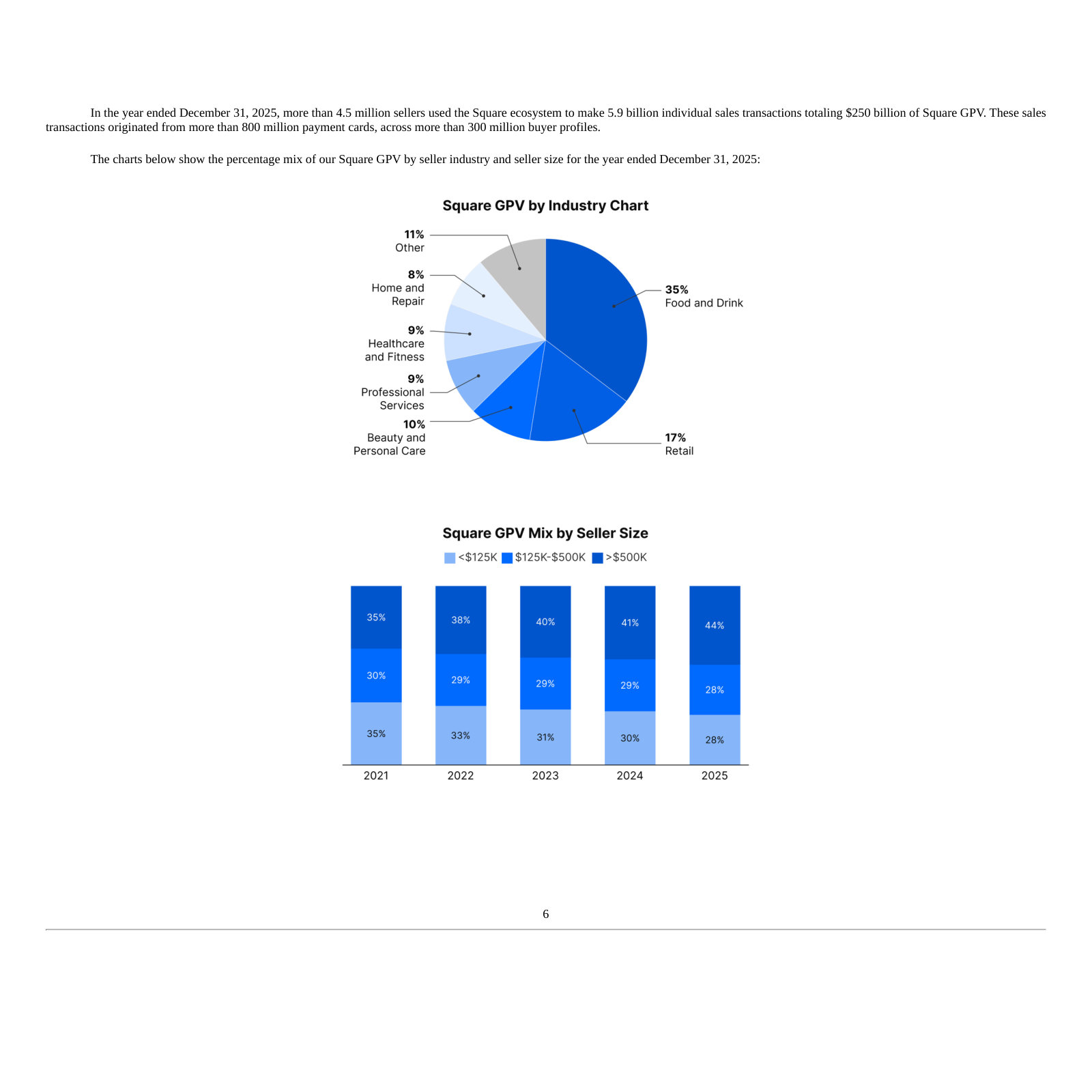
Block's most recent Square numbers: GPV growth accelerating to 13% (11.5% in constant currency), food and beverage sellers at 21% and mid-market sellers at 22%, both described as the strongest since Q1 2023, and international GPV up 35%. The last sentence is the distribution point — more than 140 active independent sales organisation partners, ramping quickly. ISOs and bank referral channels have historically been Fiserv's structural advantage in SMB acquiring, so a competitor building that channel is a change in the terms of the fight, not just a growth statistic. Figures are Block's own and unaudited.
Amrita Ahuja, CFO, prepared remarks: Turning to Square, where gross profit and GPV growth accelerated in the first quarter to 9% and 13%, respectively. On a constant currency basis, GPV grew 11.5% year-over-year, improving across both the U.S. and internationally. We accelerated GPV growth from food and beverage sellers to 21% year-over-year and from mid-market sellers to 22% year-over-year, both reflecting the strongest growth rates we've seen since Q1 2023. International GPV grew 35% year-over-year or 26% on a constant currency basis. We sustained strong new volume added growth across both the U.S. and internationally, reflecting the high ROI field sales investments we made throughout 2025. We are beginning to more meaningfully scale our independent sales organization or ISO partnerships and now have more than 140 active ISO partners who are ramping quickly.
p. 1 · Read in context →
Asked where Square's new volume is coming from and whether pricing has moved, Block gives two answers worth separating. On price, Jennings says he does not believe Block has made any major payment-pricing moves and that it has been "pretty business as usual" — a competitor declining to claim price as the lever. On volume, he describes a field sales team built from zero to more than 100, the lowest churn since Q2 2023, and "pretty meaningful win backs of those that have gone to direct competitors." The win-back and win-rate claims are unquantified management characterisations, but the direction — a competitor reclaiming sellers it had previously lost — bears directly on how contestable the installed SMB base is.
Jason Kupferberg (Wells Fargo) asking; Owen Jennings, Business Lead, answering: So you've made it really clear that you feel pretty good about the competitive momentum on the Square side of the business. I wanted to get a sense, you talked about all that new volume coming in. Is it coming more from sellers who haven't made the move to a cloud solution yet? Or is it coming more from other cloud-based providers? And then I'm just wondering if there's been any changes in the Square pricing environment, either in terms of seller sensitivity to price or pricing posture that you're seeing exhibited by your competitors? […] Yes, why don't I take this? So let me just start with the pricing point. I don't believe there's been any major significant payment pricing moves that we've made as a result of focusing on our go-to-market and as I scale the team. From my perspective, it's been pretty business as usual. And more specifically, I think a lot of what we've seen is that we're showing up in a lot more conversations as a result of getting out in the field. The field sales team going from basically 0 to over 100 today, and it will be meaningfully larger by the end of the year. That, from my point of view, is a major contributor to our ability to have greater consideration and put us in more conversations to have the chance to win. We're also seeing our telesales growth rate improving and pretty meaningfully internationally. We've seen a significant acceleration of NVA growth. So very excited about the U.S. and how we're showing up, but our telesales performance in all our global markets is seeing a highly accretive NVA growth curve. We're also seeing some of the lowest churn rates that we've seen since Q2 2023. A lot of that is a function of the investments we have made. We're showing up and supporting our partners. To wrap up the question, a lot of the wins that we're having, yes, some of them are kind of the legacy point-of-sale systems. But we, in recent times, have had pretty meaningful win backs of those that have gone to direct competitors. We're seeing really strong win rates across all aspects of our competitor base, and many who had left are seemingly coming back as we're continuing to show up and having those conversations. I'm really proud of the team and proud of what's been delivered this quarter.
p. 9 · Read in context →
Jack Henry & Associates, Inc. (JKHY)
Jack Henry competes with Fiserv's Financial Solutions segment for the same community banks and credit unions, and it is the only large core provider that publishes a count of competitive core wins each quarter. It has also made Fiserv's core-platform consolidation an explicit part of its sales pitch, which makes its disclosures the closest thing in this corpus to a running scoreboard on core attrition.
Jack Henry's own scoreboard: 22 competitive core wins in the quarter, four at institutions above $1 billion in assets, and 68% of new core wins attached to digital and card processing versus 45% a year earlier. Management says a rival's core consolidation announcement has helped its pipeline while explicitly crediting the quarter's wins to its own execution rather than to that announcement — a distinction worth keeping when the same event is used elsewhere as a Fiserv attrition thesis. The eight-year share figures are relative growth in Jack Henry's own client counts, not levels of market share, and are unaudited.
Gregory Adelson, President and CEO, prepared remarks: Second, regarding our sales performance. Our core sales team had a remarkable quarter, achieving 22 competitive core wins. Out of these, four were financial institutions with assets exceeding $1 billion, and 15 involved core digital banking and card solutions. We've witnessed a rise in trifecta wins over the past year, with 68% of new core wins this quarter including digital and card processing, compared to 45% in Q2 of fiscal year '25. The recent core consolidation announcement by one of our competitors has positively influenced our sales pipelines for core payment and complementary solutions. We anticipate our historic success rates within this client base to persist and likely accelerate based on current insights. It’s important to highlight that the timing of their core consolidation announcement had a minimal effect on our sales success in Q2; our achievements were primarily due to our ongoing demonstration of innovation and service differentiation, not only in comparison to that competitor but across the competitive landscape. […] Third, we are continuing to succeed in a consolidating market. We have consistently surpassed our competitors in core market share growth, despite the overall decline in the number of financial institutions. Over the past eight years, our core market share among banks has increased by 17%, while our credit union market share has expanded by 40%. Among institutions with more than $1 billion in assets, our market share has risen by 32% for banks and 12% for credit unions in the same timeframe. This growth occurred even as the average overall market contracted by 3% for both banks and credit unions over the last eight years.
p. 1 · Read in context →
The most specific attribution in the corpus: of 17 core wins in the quarter, Adelson says 13 came from one provider. He immediately qualifies it — core contracting runs nine to twelve months, so most of those deals were in motion before any consolidation announcement, and wins came from every competitor. The provider is not named. Jack Henry's core competitors, on its own 10-K listing, are FIS, Fiserv, Corelation and Finastra, so the concentration is informative even without the name, but attributing all 13 to any single company would go beyond what the transcript supports.
Vasundhara Govil (KBW) asking; Gregory Adelson, President and CEO, answering: It was another very strong quarter on new core wins. I'm curious what's driving this trend? And if you are starting to already see some benefits from the competitor platform consolidation or if that's still to come? […] Yes. Thanks for the question. Yes, I think it's a combination of both. We've been talking a lot about what we've been doing on the innovative side. And so that's continued to play out with the products and the solutions. Obviously, our customer service hasn't wavered a bit. I will tell you, of the 17 core wins, 13 of them came from one provider and one competitive provider. But I will say that most of those, as you can imagine, the core processing contracting side takes anywhere from nine to 12 months typically. So a lot of those were already in motion ahead of whatever announcements were made. But we did take some from really everybody, just so you know. So we had some wins from really all of our competitors. But again, the bulk of them came from one.
p. 5 · Read in context →
A competitor talking its book, and worth reading as such. Adelson says RFP activity has not meaningfully increased despite the consolidation news and points out that Jack Henry is the only provider that publishes a core-win count — a fair observation about disclosure asymmetry when comparing win claims across this group. Carsley then makes the sharpest characterisation of a rival anywhere in this corpus, describing "their long-standing lack of innovation" as having already created demand. That is an assertion by a direct competitor, not a finding, and the competitor is not named.
Darrin Peller (Wolfe Research) asking; Gregory Adelson, President and CEO, and Mimi Carsley, CFO and Treasurer, answering: Can I quickly follow up on the competitive landscape for a moment? I know this was discussed earlier, but the core consolidation at one of your competitors has been talked about a lot. Considering your expectations for core additions, have you noticed any changes in the market regarding the volume and level of RFPs in the last 6 to 12 months? […] Regarding the time frames you mentioned, a lot of recent news has emerged, including the announcement at their client conference about consolidating the cores, which has become more pronounced recently. However, I wouldn't say that the activity has significantly increased beyond what we've seen. I do expect some uptick whenever core consolidations are announced. As for capacity, we are fully prepared and can scale up as needed. We regularly manage this based on our mergers and acquisitions and new core wins. We're proficient at bringing on teams and have no concerns about that. Additionally, we've made significant advancements in AI for handling RFP responses, so we are confident in managing an increased volume of RFPs. The sales team is actively working on this, and I believe we are on the right path. I want to emphasize that we're starting Q2 strong with competitive core wins. It's also worth noting that we are the only company that announces our number of core wins, whereas others reference increases without releasing specific figures, which puts us under a different level of scrutiny. […] I agree that we are likely to experience an increase in interest and opportunities due to our competitors' core consolidation announcement. Their long-standing lack of innovation has already created demand for us to present our innovative solutions. This represents a potential acceleration. Many clients may wait until the end of their contract to change, but it presents an exciting opportunity as it reinforces our message that a change is necessary.
p. 10 · Read in context →
Adyen N.V. (ADYEN)
Adyen competes for the enterprise and platform accounts Fiserv serves through Carat, and its Platforms pillar — embedding payments, capital, issuing and business accounts into software providers — targets the same ISV and software-partner channel Clover and Fiserv's Merchant segment rely on. Adyen also lists Fiserv in its own disclosed peer group. Only the commercial and volume discussion is used here.
Adyen's self-description, and the central competitive claim behind it: a single platform built entirely in-house replacing "a fragmented, multi-party setup." That sentence is the argument made against acquirers whose stacks were assembled through acquisition, Fiserv among them. The three pillars matter for mapping the overlap — Unified Commerce is the omnichannel enterprise business that competes with Carat, and Platforms is the embedded-finance offer aimed at the software partners Clover distributes through. The in-house and end-to-end claims are Adyen's own characterisation of its architecture.
Adyen is the financial technology platform trusted by the world’s leading businesses. We simplify global commerce by replacing what is traditionally a fragmented, multi-party setup with a single platform built entirely in-house. […] We organize our commercial activities into three pillars. […] Unified Commerce connects online and in-person payments for global retailers, hospitality, and food & beverage groups. Platforms enables software providers to embed payments and financial services, including capital, issuing, and business accounts, into their offerings. With this foundation, Adyen supports the full spectrum of how money moves for the world’s largest enterprises and the fastest-growing software platforms through a single, scalable solution.
p. 9 · Read in context →
The volume disclosure that shows where Adyen is pushing. Processed volume reached €1,394.3 billion in 2025, but point-of-sale volume — the in-person terminal business that overlaps most directly with Clover and with Fiserv's merchant estate — was €310.9 billion, or 22% of the total, up from 18% a year earlier. Take rate rose to 17.0 basis points from 15.5, which Adyen attributes to merchant mix rather than to pricing. Figures are reported in euros on a non-IFRS net revenue basis and are not directly comparable to Fiserv's US-dollar merchant metrics.
Net revenue for 2025 was €2,364.2 million, up 18% from the prior year. On a constant currency basis, net revenue grew 21% YoY. Growth was driven by executing on our priorities: scaling with our existing customer base, onboarding complex enterprise and platform businesses, and investing in the foundational infrastructure required to power global commerce at scale. […] Processed volume for 2025 was €1,394.3 billion, up 8% YoY. Of processed volumes, 84% were full-stack volumes, up from 83% in 2024. In 2025, our point-of-sale volumes were €310.9 billion, comprising 22% of total processed volume, up from 18% in 2024. This growth reflects the strength of our in-person payments offering across pillars and verticals. Full-year take rate for 2025 was 17.0 bps, up from 15.5 bps in 2024. This increase was driven by changes in the overall merchant mix.
p. 16 · Read in context →
Nexi S.p.A. (NEXI)
Nexi is the scaled European incumbent in the merchant acquiring and issuer processing markets Fiserv entered through First Data and still serves from Europe, and it is named alongside Fiserv in Global Payments' own issuer-competitor list. Its reporting is the clearest read in this corpus on European digital-payment growth rates, which sit behind the international line of Fiserv's Merchant segment.
A competitor's account of how fast the European digital-payments market is actually growing: nominal growth decelerating from +12% in 2022 to +5% in 2023 and +2% in 2024, with a further slowdown to about +6% in payment transactions estimated for 2025, and physical POS terminals in Italy up only 2% after 6.9% the prior year. The figures are drawn from Banca d'Italia and Milan Politecnico and are heavily Italy-weighted, so they describe Nexi's home market more precisely than Europe as a whole. They are a useful counterweight to the mid-to-high single-digit secular growth assumptions usually applied to payments.
Market trends in 2024 confirm a further slowdown in digital payments as a result of the weakening consumer economy (falling from +12% in 2022 to +5% in 2023, and to +2% in 2024 in nominal terms), although digital payment penetration has continued to grow steadily by around 2 percentage points each year since the pandemic. […] Data from Banca d’Italia show that cash withdrawals are falling even more than in the previous year (-1% in 2023 and -3% in 2024), while payments continue to rise, albeit more slowly, recording +7.5%. In 2025, based on data observed in the first half of the year, Milan Poly technic estimates a further slowdown in payments (+6%). […] Structural dynamics are also accompanying the transition to digital payments, but they also slowed. According to the Banca d’Italia’s Annual Report, there were 3.3 million physical POS devices in circulation at the end of 2024, an increase of +2% over the 6.9% of the pre vious year, while the number of ATMs fell from 46 thousand in 2023 to 44.7 thousand in 2024 (-2.8%).
p. 16 · Read in context →
Nexi's own account of its scale and its dependence on banks. More than 42 billion transactions and Euro 1,822 billion of value handled across acquiring and issuing in 2025, on the same page that splits the group into three business lines — Merchant Solutions, Issuing Solutions and Digital Banking Solutions — mapping closely onto Fiserv's own Merchant and Financial Solutions split. The last sentence is the structural point: where Nexi sits in the value chain, and whether an activity is run internally or outsourced, varies with "the nature of the Group's relationships with partner banks." That is the same bank-distributed model Fiserv relies on across much of Europe, and it means the two compete for bank partnerships as much as for merchants. The volume figures are pro forma and unaudited, and count volumes handled directly or through partners rather than by Nexi alone.
Present in over 25 countries, Nexi is one of the leading players operating in the digital payments sector in Europe […] In 2025, directly or through its partners, the Nexi Group managed an aggregate volume of more than 42 billion transactions for the entire value chain on the acquiring front and on the issuing front, corresponding to a total amount of Euro 1,822 billion (pro forma data) […] The services provided by this company unit can be subdivided into payment processing services, payment acceptance services (or acquiring services), and POS management services. Nexi operates under several service models, which vary depending on the nature of the Group’s relationships with partner banks, which vary and, therefore, determine value chain presence, and the relative activities are managed internally and/or outsourced depending on the service models.
p. 21 · Read in context →
More peer documents
JKHY_annual_report_FY2025 — 66 pages · Jack Henry's own Form 10-K competition section, which names Fiserv as one of only four core competitors alongside FIS, Corelation and Finastra, and states that provider consolidation in bank and credit-union technology has run for more than a decade and is expected to continue (p12). · Open →
GPN_annual_report_FY2024 — 128 pages · The prior-year competition disclosure, which still lists Worldpay as a US acquiring competitor and still expects the issuer competitor set to keep expanding — the baseline for reading how the FY2025 wording changed (p11). · Open →
Q2_FY2025 — 14 pages · Global Payments' Q2 2025 call: the Worldpay deal rationale in management's own words, with the nearly $4 trillion and 100 billion transaction framing used to claim "unmatched global scale" (p3). · Open →
Q4_FY2025 — 11 pages · FIS's Q4 2025 call: management answering an analyst on issuer-processing competitive dynamics as larger networks move into the space (p6-7), and its claim of having renewed or extended relationships accounting for approximately 30% of total issuing revenue over the prior twelve months with no large renewals pending in 2026 (p2). · Open →
FIS_annual_report_FY2025 — 112 pages · The 10-K Competition section (p9) plus the risk factors on clients keeping work in-house, emerging technologies unbundling bank solutions, and smaller and mid-size clients exerting pricing pressure at renewal (p17-18) — the same renewal dynamic Fiserv faces in Financial Solutions, described by the closest comparable filer. · Open →
ADYEN_annual_report_FY2024 — 262 pages · Adyen conceding a "still relatively small market share — even in our most commercially established regions, like EMEA" (p12), and the disclosed peer-group table that lists Fiserv among payment platforms (p85). · Open →
Q4_FY2025 — 13 pages · Block's Q4 2025 call: Dorsey answering whether AI is a competitive vector where Block can leapfrog the incumbent point-of-sale providers, and what gives Block the right to win there (p12). · Open →
NEXI_annual_report_FY2024 — 382 pages · The prior-year Reference Markets section, needed to check whether the European growth deceleration Nexi describes is a trend or a single-year restatement — it shows the same series a year earlier at +14% in 2022 and +6% in 2023 (p15). · Open →